

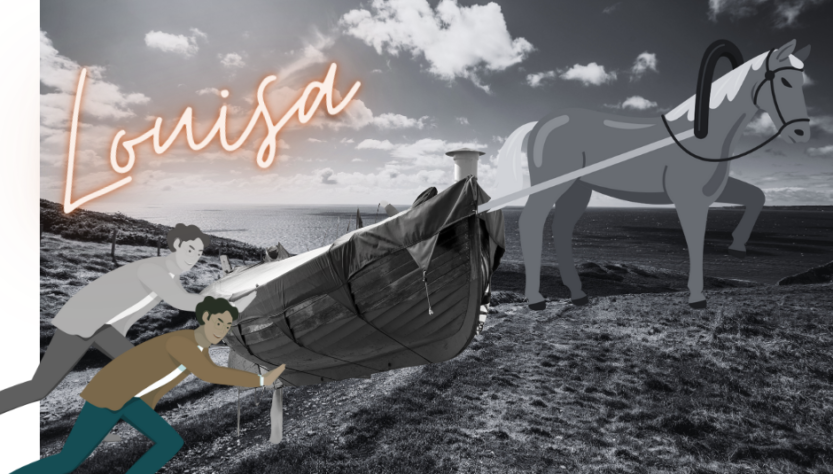
Lifeboat Louisa was unable to launch at Lynmouth in the storms of 1899, and so the lifeboat crew pulled the boat 13 miles by land and safely launched her from Porlock Weir. All lives on the stricken Forrest Hall sailing ship were saved.

2024 marks the Bicentenary year of the RNLI. Amongst the highlights of events this year is the re-enactment, on 13 January 2024, of the famous launch of lifeboat Louisa from Lynmouth station 125 years ago. – Recently the locals walked the route pulling a modern-day lifeboat rib and raising funds for the RNLI.
This courageous rescue is well documented all-over the North Devon Coast – for the bravery of the lifeboat crew, their epic 13 hour journey to launch the boat and safe rescue of all on board the distressed ship. And its worth a visit to see a replica of Louisa at the entrance to the Glen Lyn Gorge in Lynmouth.
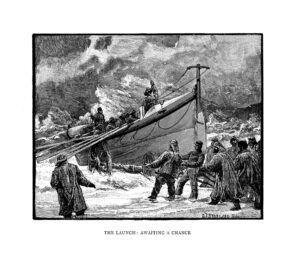
“Louisa” had arrived in April 1887. She was a 10 m long boat, with 10 oars and 2 masts, built by Woolfe and Sons in London at a cost of £298 14s. On a shout, crew men would row out to boats in distress, risking everything. It was Worcester vicar, Rev’d Thomas Littleton Wheeler who donated funds to buy the boat.
Historical census notes that Rev’d Wheeler and his wife had two visitors to their Worcester home, who originated from Exmouth – Elizabeth and Louisa Loscombe. There is speculation that may be it was this Louisa who was the namesake for the Lynmouth Lifeboat!
It was the night of 12th January, 1899. At sea the weather stormy and perilous.
A trade ship named the Forrest Hall, a three masted 1900 ton schooner, was travelling from Bristol, along the Bristol Channel, to Liverpool. She was under tow when she lost her rudder and the line to her Tug broke and the ship started to drift badly towards the shore of the North Devon Coast.
A distress call was sent out . The Watchet Lifeboat crew, who were the first called, were unable to launch and row out in such horrendous conditions. And so at 19.52, the Lynmouth Lifeboat crew received the request for assistance with lifeboat Louisa.
Responding to the call, the crew members knew it was too stormy to launch the Louisa from Lynmouth that night; the storm had already caused much flooding and damage in Lynmouth village. And coxswain Jack Crowcombe knew it would be impossible to launch right then.
Loyal to their calling to save lives at sea, the crew made an astounding decision – to launch the boat from neighbouring Porlock Weir. The youngest crew member was one 16 year old Billy Richards.

It wasn’t just a gentle trip down the road, but a 13 mile heroic haul of the boat up and down steep hills on the coast line heading east into Somerset, to the relatively quiet cove at Porlock.
Over 100 local people , many of whom had come to hear about the rescue launch, became involved moving the Louisa along the route. 18 horses were recruited from nearby farms at Lynton to pull the carriage and together with the 100 helpers, the boat was literally hauled over all terrains to its launch point. Some men had to work up ahead – widening the road in parts and lighting the way. The horses pulled and the locals pushed the boat up the first incline.
A wheel came off the carriage at one point, at the top of the climb , near Blue Ball Inn. And that was repaired. A lot of women and children headed for home at that point, whilst some 20 men and crew carried on. Later the road near Ashton was too narrow so the boat was lifted off the carriage to clear the walls and then replaced.
The journey was arduous – a steep 25% incline up Countisbury Hill, before crossing the moor. Then men had to steer the boat down the steep Porlock Hill to the bottom – again a 1 in 4 gradient, descending a height of 434 metres. More horses had been recruited and replaced 4 who died on the journey.

At the Porlock end, another narrow road was widened by taking down a garden wall and on the final approach to Porlock Weir, the track route was too high to pass under a tree. That was felled and cleared and the Louisa got to her launch point. It was 6.30 am.
That was just the start of the rescue.
The men immediately jumped aboard and started rowing Louisa out to sea towards the drifting Forrest Hall. Members of the lifeboat crew climbed aboard and helped the exhausted crew of 13 keep her steady and secure to two tugs at daybreak. The tugs did their work to save the boat from drifting onto the rocks.
Our courageous crew then rowed on to Barry, South Wales, to support the Forrest Hall’s safe arrival at 6pm that evening . Following food and rest at the Seamen’s mission , the lifeboat crew rowed back to Lynmouth the next day , with the help of a tow from a steamer, – to a hero’s welcome.
In 2024, some grandchildren of the original Louisa Crew took part in the latest re-enactment and told the stories passed down from this heroic RNLI rescue.